In Northern Colorado, uses of force by police get examined by a team of investigators from different agencies. It can bring more transparency and objectivity to the process. But just how much do these investigations hold police accountable and increase trust?
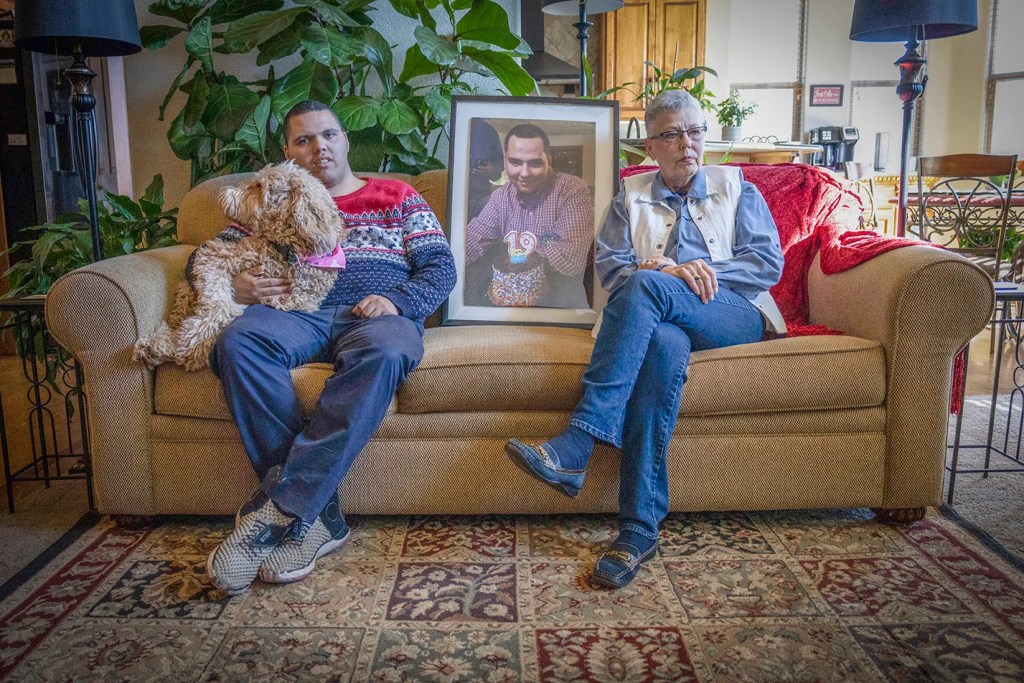
Judy Domina, left, says she wouldn’t call the police again, even if she faces a similar situation with her grandson Alex’s older brother Zachary, who also has mental health challenges. (Photo by Zach Tuttle)
FORT COLLINS, Colorado – An elderly woman with dementia walks off with about $14 merchandise from a big-box store. Confused, she’s confronted by police officers, who can’t get her to halt and wrestle her to the ground, snapping her arm.
A teenager wielding a knife is shot four times by an officer in his grandmother’s backyard after she called police to help him through a mental health crisis. He ends up dying.
As in the case of Cedric “C.J.” Lofton, who died in Sedgwick County’s juvenile detention center in 2021, an independent law enforcement agency investigated the above situations. A local prosecutor similarly made the decision on whether to file charges, producing a lengthy report in the process.
But because the above incidents took place in Larimer County, Colorado, a detailed, formalized process exists to help determine whether police acted lawfully in using force, an approach that doesn’t exist in Sedgwick County. In the case of the elderly woman, it led to charges against the officers. Such a review kicks in anytime an officer inflicts bodily harm or a fatal injury.
These efforts involve investigators and forensic specialists from law enforcement agencies across two northern Colorado counties. As many as 30 people from a variety of local agencies can be involved in a case. To help maintain the integrity of the investigation, the involved law enforcement unit cannot lead the probe.
Nearly two decades since the 8th Judicial District’s Critical Incident Response Team (CIRT) was launched, proponents such as District Attorney Gordon McLaughlin say the systematic approach has bolstered community confidence and made law enforcement agencies more transparent and accountable, leading to less aggressive policing and greater community trust. While his rationale may be valid, there is no supporting data to prove it.
Critics, however, see an effort that doesn’t go far enough to ensure that community concerns about rogue policing are being addressed. Even if other jurisdictions are involved, they say, police are still investigating their own.
Nevertheless, the CIRT, which grew out of an effort to look at best practices around the country, represents an approach that appears to be relatively rare. Law enforcement agencies, and the officers who work for them, do not usually subject themselves to additional levels of scrutiny in hopes of reassuring the public. And it’s scrutiny that law enforcement there enthusiastically supports. There’s now a state law that requires all Colorado jurisdictions to have some form of this review.
But questions remain about whether the public in more places, such as Wichita, will ever ask for increased scrutiny of uses of force by law enforcement or be content with a status quo that treats most incidents as internal police matters.
 Angela K. Evans