New Colorado police reform law nullifies qualified immunity, though the doctrine still stands at the federal level
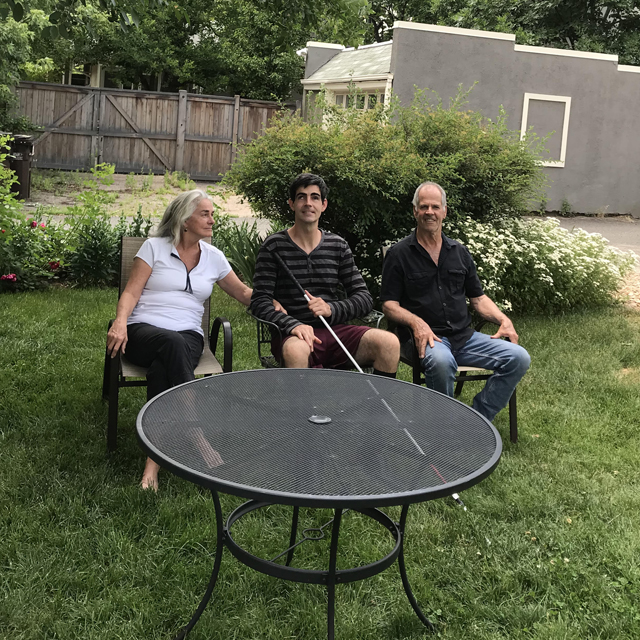
Ryan Partridge (center) with his parents, Shelley and Richard, at their home in Boulder. Ryan blinded himself during a psychotic episode at the Boulder County Jail in 2016. A judge has said the Sheriff’s Office is not liable for Ryan’s injuries due to qualified immunity, a legal defense that many police reform advocates say offers too much protection to officers.
As Ryan Partridge was held in the Boulder County Jail over the course of nine months in 2016, his mental health quickly deteriorated. Previously diagnosed with schizophrenia, he was admittedly paranoid and delusional, distrustful of the jail deputies and mental health staff. On several occasions, he says, he was tased, left in a restraint chair for hours, and held in solitary confinement or “discipline” for days, even weeks, at a time. It all culminated on Dec. 16 of that year, when in the throes of a psychotic episode, he gouged out his eyes with his fingernails.
Boulder Weekly first wrote about Ryan a few years ago (see “Silent Screams,” Feb. 8, 2018), when his family initially brought a civil lawsuit against the Boulder County Sheriff’s Office and more than a dozen of its jail employees. Filed in federal district court in Denver, the Partridges claim the agency violated Ryan’s constitutional rights by using excessive force, being deliberately indifferent to his serious mental illness and failing to provide medical care and treatment on 13 specific incidents while he was in custody.
But in March 2019, most of the case was dismissed by a judge, who ruled that the Sheriff’s Office and its employees were not liable for Ryan’s injuries due to the legal defense of qualified immunity, (although a handful of excessive force claims are still being litigated). It’s a doctrine that’s been thrust into the national conversation about police accountability, as it often protects government officials from being held personally liable in federal court for violating people’s civil rights, including interactions with the police.
“I feel a lot of empathy for other people who are going through this and who are protesting,” says Ryan’s mother, Shelley. “It’s one of these things where until it happens to you, you don’t believe it, you don’t notice it, you don’t pay attention. And now you’re very hyper-attentive to it all. And none of it is good news.”
Qualified immunity is “a judge-created principle and defense,” says Suzette Malveaux, professor of civil rights and constitutional law at CU-Boulder. The ability to sue state officials for monetary damages in cases of civil rights violations dates back to 1871 and Section 1983 of the Civil Rights Act, a Reconstruction-era law that sought to protect African Americans from Ku Klux Klan violence. But for more than a century, Malveaux says, the courts interpreted the law in such a narrow way that it was hardly ever used. That is until the 1960s, when lawyers began using Section 1983 aggressively to challenge civil rights violations, often winning their cases.
Read more here.
 Angela K. Evans