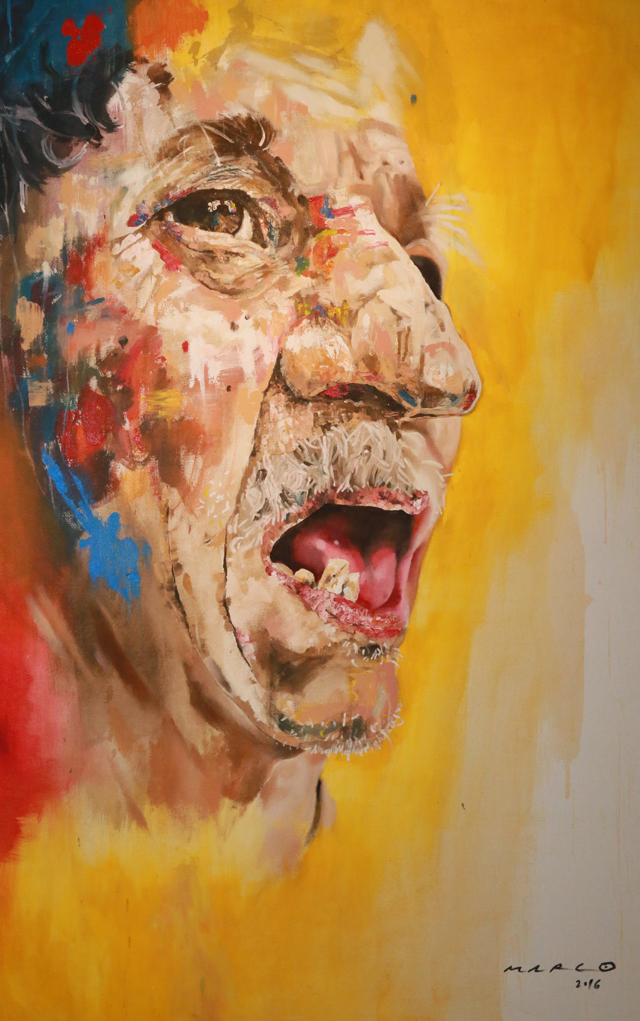
“El Peso de Trabajo (The Weight of Labor)” by Marco Antonio Garcia Noguera
As a young man living in Venezuela, Jose Garcia remembers being woken up in the middle of the night by his mother to watch tanks storm the Miraflores Palace in the capital of Caracas. It was 1992, and the Venezuelan military, led by Hugo Chavez, was attempting a coup d’edat against the democratically elected President Carlos Perez. In the end, the coup failed and Chavez was imprisoned.
Only four years later, Chavez himself was democratically elected president of the country, with roughly 60 percent of the population voting for him, including Garcia.
“The sentiment was that the system was basically serving itself,” Garcia says. “People revolted against the system and basically wanted another revolution. But revolutions don’t guarantee a better state.”
Garcia says he witnessed first hand the aggressiveness and corruption of previous governments, and therefore, like the majority of his country, wanted radical change.
“My father was shot and almost killed before Chavez came to power,” he says. Incorrectly assuming Garcia’s father, a cattle rancher in the Andean city of Merida, was driving a stolen vehicle with hopes to sell it in nearby Colombia, law enforcement “just came up, no questions asked, and shot him with a military rifle. So that was the kind of stuff that [Chavez] said they were going to change.”
Over the next decade, Chavez increasingly consolidated political power while nationalizing private industry, all in the name of his socialist revolution. At the same time, global oil prices surged to all time highs and with its oil-rich lands, money poured into Venezuela.
“Those were good years,” Garcia says. “There was plenty of money in the streets, people were eating. When you have such a landfall of money, it doesn’t matter if you’re running the economy into the ground.”
Now, just three years after Chavez’s death, Venezuela’s economy is in complete disarray as inflation has reached 720 percent in the last year and the International Monetary Fund estimates it could reach 1,600 percent in 2017. And President Nicolás Maduro, Chavez’s named successor, has faced increasing unrest as thousands of protesters gathered in the beginning of September demanding a recall referendum, hoping to oust the leader by the end of the year.
Continue reading here.
 Angela K. Evans